
Originally published in the Spring 2022 edition of the Virginia Defender, issue 68, printed April 21. Reproduced here for accessibility and archival purposes. To find other stories in the Spring 2022 issue or to download the full PDF, see this post. For other issues dating back to 2012, see the Full Issues page.
Editor’s Note: In 2020, Princess Blanding, a public school educator and sister of police shooting victim Marcus-David Peters, became the first African-American woman ever to qualify for the ballot for the position of governor of Virginia. She ran as a candidate of the Liberation Party, which she founded after becoming disillusioned with how the Democratic Party had dealt with the demands of the 2020 Black Lives Matter Rebellion. The Virginia Defender recently interviewed her about that political journey
What happened after you made ballot status?
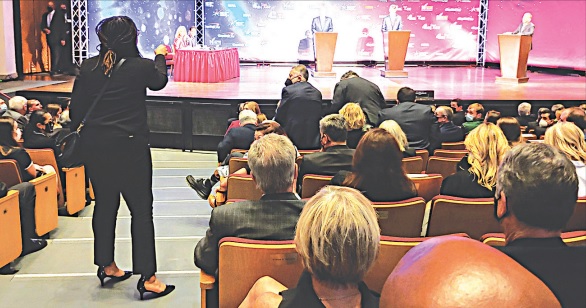
It was the first time a Black woman and an openly LGBTQIA+ person had made the ballot in Virginia for the position of governor. But then after we got on the ballot, I was excluded from the two gubernatorial candidates debates. I was invited to come to watch the second debate, but was told I would not be allowed to participate. I felt like I was allowed to get on the bus, but would have to sit in the back of the bus, and that did not sit well with me.
And there was no good justification other than that was the way things had always been done, with just the two major parties invited to participate. It had nothing to do with how much money we raised or how many signatures we had gotten. And that’s when I spoke up at the debate. I made my voice heard, and let people across the Commonwealth know that I was a candidate.
What about the legislation, the bills dealing with demands that came out of the Black Lives Matter protests of 2020?
We worked on two bills, for the Marcus Alert and Civilian Review Boards. And I was consulted about the bills to end qualified immunity for police officers.
The legislators and eventually the governor considered putting the bills on the agenda because of fear of the rebellion. They wanted the tension to calm down, so their strategy was, “Let’s make them think we are listening to them.”
At that time, the Democratic Party was the majority party and pretended to be for the people. And they had the power to pass the legislation, but they watered it down.
The Marcus Alert bill, named after my brother, was supposed to call for the first responders to a mental health crisis situation to be mental health professionals, with police only as back-up, not in uniforms or marked cars and only using nonlethal force, if indeed they had to be involved. That all was shot down. And the final bill just calls for pilot projects now, with statewide implementation not until 2026.
And the Civilian Review Board?
We see how this is a problem now in Richmond, where some activists objecting to Mayor [Levar] Stoney’s bill had previously supported Sen. [Ghazala F.] Hashmi [D-District 10] in allowing the boards, but not making them mandatory. How many police departments would say they want to be held accountable?
The bills on qualified immunity were killed twice under Northam, in the regular session and then in the special session, while the Democrats were in the majority.
That’s when you decided to run for governor?
We rolled out our campaign in December 2020, after the 2020 session. We cannot keep begging our oppressors to be our saviors. After working with Jennifer McCullen, Ghazala Hashmi, Jeff Bourne, we saw we were putting our efforts behind these legislators who … they wanted me involved because they thought I was a big part of the uprising, but they weren’t serious. So I came to the conclusion that what we needed was a strong, independent party.
Where is the Liberation Party at now?
In a nutshell, we’re going to be boots on the ground and build the Liberation Party. A lot of people still don’t know about the party, so we need to move around the state and be a niche in the community, to work with the community to address their concerns.
In western Virginia, the Mountain Valley Pipeline is still a huge issue. In general, environmental concerns are very high. And the havoc that inflation is wrecking on us. Criminal justice is still a big priority. It depends where you’re at in the state. An issue may be more pressing in one place than in another.
Will the party be running candidates?
At this time, there are no plans to run candidates, but that’s part of our plans for the future, like for school boards, any leadership position in the community. And the Liberation Party would like to help support other campaigns that are willing to run either as independent candidates or as the Liberation Party. You don’t have to be part of the Liberation Party for us to support you. We endorsed Marilyn Hoffman, the Green Party candidate for governor in New Jersey and she endorsed our run for governor in Virginia.
So how can people get involved in the Liberation Party?
Just go to www.liberationparty.org to sign up to volunteer or donate. Right now, blue looks like red and red looks like blue. We need a party that stands for the people. The two major parties are only concerned about their own financial gains or their political gains, and that’s not us.
Categories: Community News
 The Virginia Defender